

Top 2% Scientists
The editorial home of the Stanford/Elsevier Top 2% Scientists list: release news, clear methodology guides and rankings by field and country.
Visit top2percentscientists.com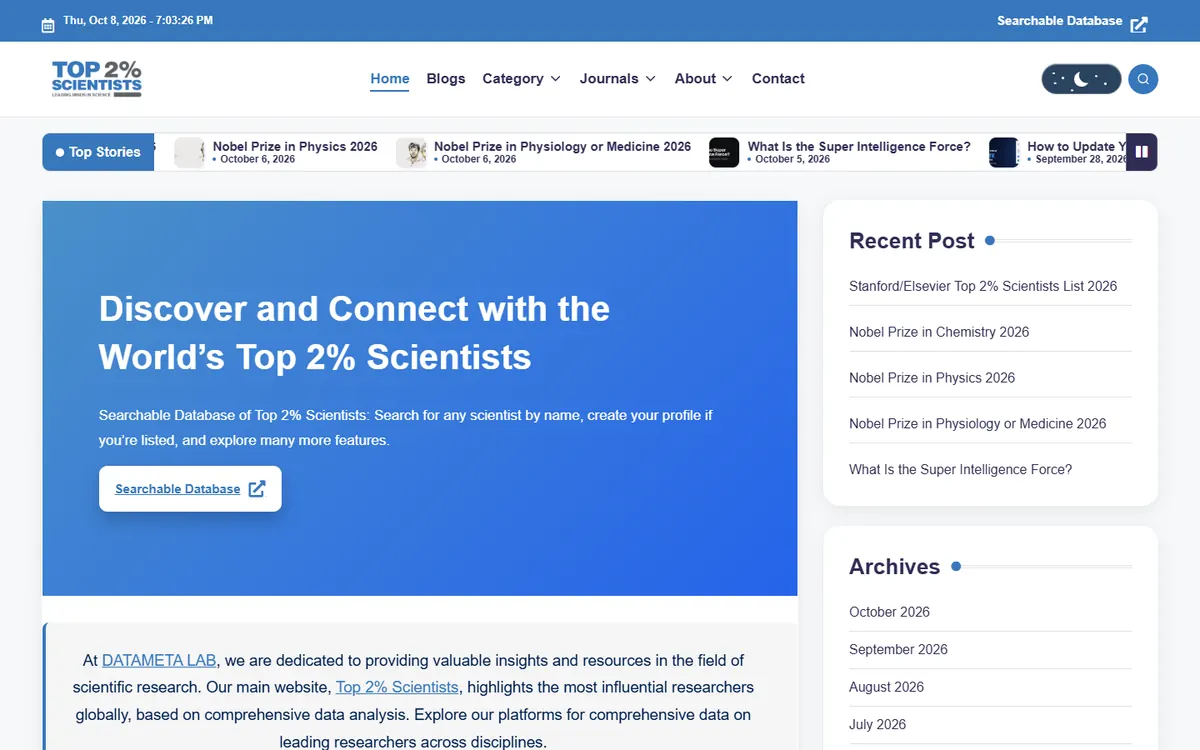
What Top 2% Scientists is
Every year, a team led by Prof. John P.A. Ioannidis at Stanford University publishes a database of the world's most-cited researchers, built from Elsevier's Scopus data. It is widely known as the “Top 2% Scientists list”. It is also a very large spreadsheet with dozens of columns, published on a data repository without much explanation, and it is easy to misread.
Top2PercentScientists.com was the first platform DATAMETA LAB built, and it exists to close that gap. It is an editorial site: it reports each new release as soon as it appears, explains what the indicators mean, and turns the raw tables into readable rankings: the top researchers in each country, the top 100 in each field, and analysis of how the list changes from year to year.
The site does not host the search tool itself. When readers want to look up a specific scientist, they are sent to TOPSCINET, our dedicated search and profile platform. Keeping the two apart lets the editorial site stay fast and readable, and lets the search platform focus on data.
Top2PercentScientists.com is independent. It is not affiliated with Stanford University or Elsevier, and it has no role in producing the list or deciding who is on it.
Key features
Release coverage
Each annual edition is covered on the day it appears on the Elsevier Data Repository, with the version number, the Scopus snapshot date and a link to the official dataset, so readers can tell the real release from the unofficial files that circulate before it.
Methodology explainers
Guides to the composite c-score, the difference between the career-long and single-year rankings, how fields and subfields are assigned, and why self-citations and retractions are reported alongside the scores.
Rankings by country and field
Two recurring series, Top 10 Researchers by Country and Top 100 Researchers by Field, turn the dataset into lists people actually want to read and share.
Analysis and trends
Articles on how the list shifts between editions: which countries and institutions are growing, how the field mix changes, and what the numbers can and cannot tell you.
Nobel Prize coverage
Profiles of each year's Nobel laureates in the sciences, cross-referenced with their citation records.
Journal resources
Reference pages for researchers choosing where to publish, including a list of HEC-recognised Pakistani journals.
Who it is for
Researchers. Checking whether they made the latest edition, understanding their score, or learning how the list is put together before quoting it in a CV or grant application.
Universities and research offices. Tracking how many of their staff appear each year and finding the right official source to cite in announcements.
Journalists and the public. Looking for a clear, sourced explanation of a list that is often reported loosely as a “Stanford ranking”.
How to use it
- 1
Start with the latest release post for what is new in this year's edition and a link to the official dataset.
- 2
Read the methodology guides before drawing conclusions, especially the difference between career-long and single-year impact.
- 3
To look up a specific scientist, follow the “Searchable Database” link to TOPSCINET.
Frequently asked questions
Is Top2PercentScientists.com the official list?
No. The official list is the dataset published by Prof. Ioannidis and colleagues on the Elsevier Data Repository. Top2PercentScientists.com reports on it, explains it and links to it, and is not affiliated with Stanford or Elsevier.
Can I search for a scientist on this site?
Searching has moved to TOPSCINET, which holds both the career-long and single-year data for every edition. The editorial site links to it from every page.
How quickly is a new edition covered?
New editions are reported on the day they appear on the Elsevier Data Repository. The 2026 edition, for example, was published on 7 October 2026 and covered the same day.